


SUV vs crossover: What’s the Difference and Which One Is Right for You?
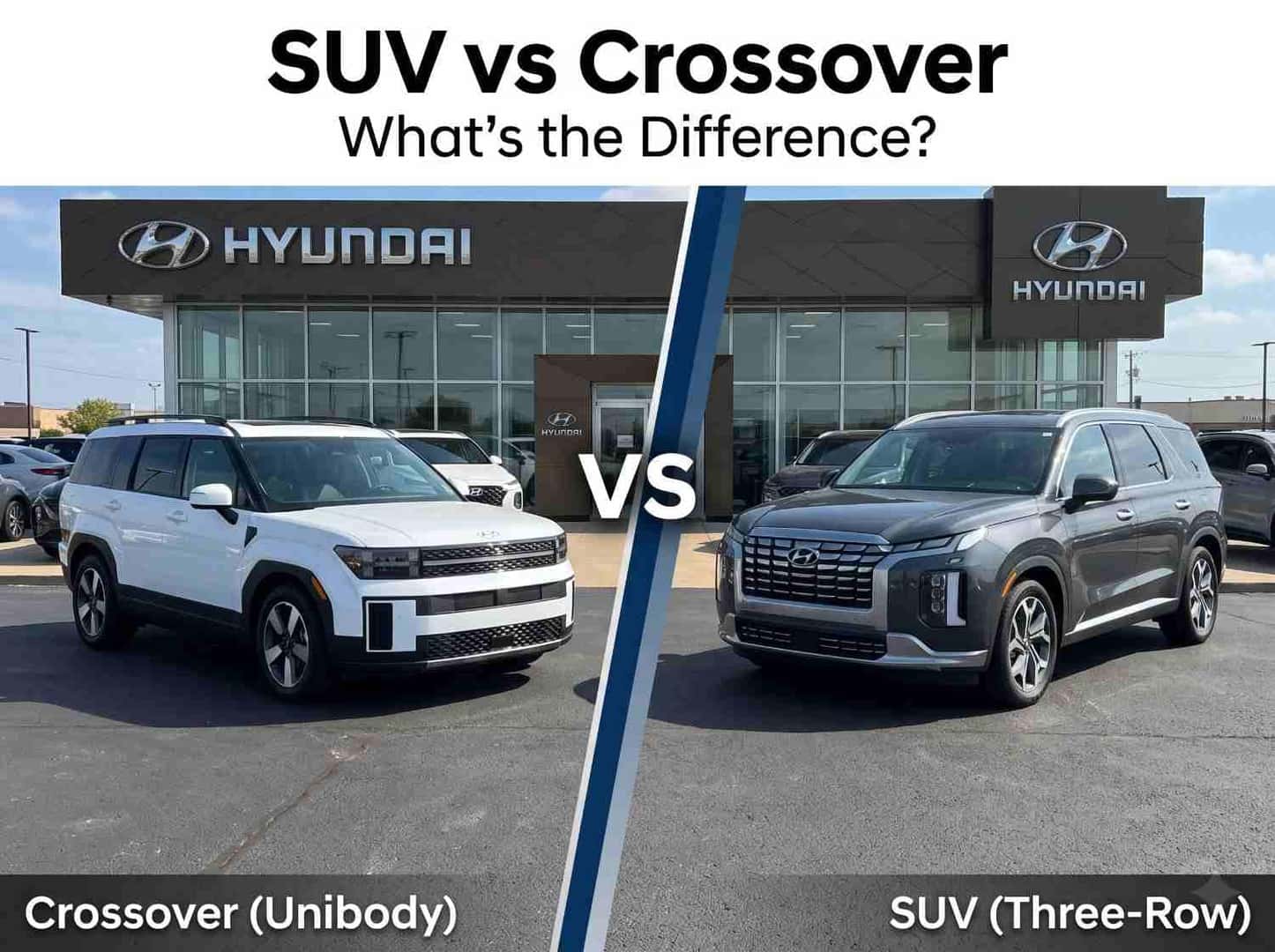
Walk any dealership lot and you will notice every tall vehicle gets slapped with an SUV badge. Trying to decode the SUV vs crossover question is frustrating when marketing departments blur the lines constantly.
But a real distinction exists. The honest answer comes down to two specific things: how the vehicle is constructed underneath, and its physical footprint on the road.
We will sort this out using the current Hyundai lineup to help you make a smart choice. Here is the short version of what actually separates them.
Quick Summary
The core difference between SUV and crossover models comes down to the skeleton. A traditional SUV uses a body-on-frame build like a truck. A crossover relies on unibody construction like a car. Crossovers generally deliver a smoother ride and better fuel efficiency. Body-on-frame SUVs handle heavy towing and hard off-road trails better.
Key Takeaways
- Crossovers use unibody construction; traditional SUVs use a truck-like body-on-frame structure.
- Most SUVs sold on dealership lots today are technically crossovers.
- Unibody designs generally deliver a smoother, lighter, more car-like ride.
- Body-on-frame builds are better suited for heavy towing and hard off-roading.
- Vehicle size class and frame construction are completely separate questions.
- Hyundai’s entire SUV lineup utilizes modern, car-based unibody platforms.
What Is a Crossover SUV? (Crossover SUV Meaning)
If you find yourself asking exactly what a crossover SUV is, the answer lies in its hidden skeleton.By definition, a crossover features the tall stance and cargo space of an SUV, but is built on a car-style unibody platform.
Historically, an SUV meant something very specific. It was a rugged, body-on-frame machine built exactly like a pickup truck. You bolted a heavy steel body directly onto a separate, rigid steel ladder frame.
I see this disconnect play out constantly. A family walks in asking to test drive our newest SUVs. But their actual daily checklist, a smooth highway ride, easy parking, and sharp handling always points them straight to a crossover.
Is a Crossover Really an SUV?
In everyday language, absolutely. The terminology blurred a long time ago. Most shoppers and automakers simply use the acronym “SUV” as a catch-all phrase for any tall, spacious vehicle.
The strict dividing line remains purely about how they are constructed at the factory. But even that gets messy.
Not every highly capable off-road SUV relies on an old-school truck frame. The unibody Land Rover Defender is a well-known example of that engineering shift.
Unibody vs Body-on-Frame SUV: How They’re Built
The heart of the unibody vs body on frame SUV debate is simple structural engineering. A unibody vehicle merges the body and chassis into one continuous shell, whereas a body-on-frame design bolts a separate cabin onto a heavy ladder frame.
That structural choice is the true difference between SUV and crossover models sitting on our lot. Unibody platforms act like beefed-up cars. Engineers stamp the floor, roof, and pillars together into a single, cohesive, lightweight cage.
Body-on-frame is exactly how automakers build heavy-duty pickup trucks. You have a massive steel ladder chassis underneath. The engine, suspension, and wheels attach directly to that bottom frame. Then the passenger cabin simply drops right on top.
So why does this matter to your daily commute? Because the skeleton dictates exactly how a vehicle will behave on the pavement. I always remind shoppers that physics never lies.
Heavy truck frames bounce and shudder over broken pavement. A rigid, single-piece unibody shell absorbs those everyday bumps cleanly. It is the reason most families prefer a crossover’s road manners after a quick test drive.
| Feature | Crossover (Unibody) | Traditional SUV (Body-on-Frame) |
| Construction | Single merged structure | Separate body bolted to ladder frame |
| Ride feel | Smoother, car-like | Truck-like, often bouncier |
| Weight | Generally lighter | Noticeably heavier |
| Fuel economy tendency | Usually more efficient | Tends to consume more fuel |
| Towing and hauling | Light to moderate duty | Built for heavy loads |
| Off-road ability | Dirt roads, light trails | Severe trails, rock crawling |
| Everyday handling | Agile, easy to park | Bulkier, wider turning radius |
| Typical examples | Toyota RAV4, Honda CR-V, Hyundai Tucson | Ford Bronco, Jeep Wrangler, Chevrolet Tahoe |
Crossover vs Traditional SUV: Which Is Stronger?
Shoppers often assume heavy truck frames are inherently better. When comparing a crossover vs traditional SUV, “stronger” totally depends on the actual job.
Body-on-frame architectures handle punishing towing weights and brutal, frame-twisting rock trails far better. But modern unibody shells are incredibly rigid and tough. For hauling kids, grabbing lumber, and surviving winter potholes, unibody construction is vastly superior. A one-piece structure actually flexes less during high-speed cornering.
SUV vs Crossover Pros and Cons
When weighing SUV vs crossover pros and cons, crossovers easily win on daily comfort, fuel efficiency, and everyday usability. But traditional body-on-frame SUVs still hold the crown for heavy towing and brutal off-road work.
We talk to shoppers every single week who insist they absolutely need a massive, heavy-duty truck frame. They picture themselves hauling huge trailers or crawling over jagged boulders. But then we actually examine their weekly routine.
Most buyers’ real driving needs fit a crossover perfectly. You just don’t require a heavy steel ladder frame to grab groceries, commute in the rain, or take the kids to school.
Choosing a truck-based SUV when you only drive on pavement means paying a daily penalty. You’ll burn more gas constantly. The stiff suspension bounces harshly over every single pothole. And parking in tight spots becomes a massive chore.
So let’s strip away the confusing marketing hype right now. Here is a completely honest look at where each specific build style genuinely excels, and where they’ll eventually frustrate you on a daily basis.
| Category | Crossover | Traditional SUV |
|
Pros
|
Smoother, car-like ride quality | Heavy-duty towing capability |
| Better fuel efficiency tendency | Rugged off-road performance | |
| Easier to park and handle | Durable truck-like frame strength | |
| Lighter overall vehicle weight | Higher ground clearance typically | |
|
Cons
|
Limited to lighter towing tasks | Stiffer, bouncier daily ride |
| Not built for rock-crawling trails | Lower fuel efficiency tendency | |
| Less rugged undercarriage | Harder to maneuver and park | |
| Lower maximum payload limits | Heavier overall vehicle weight |
Crossover SUV Advantages
Why do these vehicles absolutely dominate the roads today? The main crossover SUV advantages come straight from their car-based DNA. You get the tall stance and cargo space of a big vehicle without the penalty of driving a heavy truck.
- Smoother ride: Unibody frames absorb road imperfections cleanly.
- Better efficiency tendency: Less weight means the engine works less.
- Easier parking and handling: They turn and stop just like a standard sedan.
- Wide variety: They offer endless size options and reliable AWD systems.
Those perks check every box for a busy family.
Crossover vs SUV for Families
When evaluating a crossover vs SUV for families, most households do incredibly well with a standard unibody crossover. You only really need to size up to larger or three-row models if you regularly carry more than five people or tow heavy loads.
I watch this exact debate happen on our lot constantly every single weekend. Families usually finalize their big decision only after actually loading a bulky stroller into the trunk or clipping a real car seat into the back row. Doing that hands-on physical test always proves way more than just reading online spec sheets.
What families should check:
- Total number of available seats and passenger rows.
- Car-seat fit, hidden LATCH anchors, and wide rear-door openings.
- Usable daily cargo space with all the rear seats left up.
- The actual ease of getting in and out for young kids.
- All-wheel-drive availability for safely handling wet or icy roads.
- Standard driver-assistance features for long highway road trips.
Three-row crossovers like the redesigned 2026 Hyundai Palisade give you massive family space without resorting to a stiff, truck-like body-on-frame construction. You get comfortable seating for seven or eight people in a vehicle that still rides gracefully on the highway.
Crossover SUV vs Midsize SUV: It’s About Size, Not Just Construction
When comparing a crossover SUV vs midsize SUV, the confusion happens because “midsize” simply describes physical dimensions, not how the vehicle is actually built. This means a midsize SUV can absolutely be a unibody crossover.
Size classes just dictate the footprint and cabin volume. Construction type is a totally separate engineering choice. You can find a compact body-on-frame truck, just like you can buy a massive three-row unibody family hauler.
Our customers get tripped up by these overlapping labels constantly. They’ll ask for a midsize model, thinking it somehow guarantees a heavy-duty frame.
Here is how Hyundai structures its unibody lineup purely by size. And remember, the Santa Cruz isn’t an SUV. It’s a compact pickup, though it shares unibody roots with the Tucson crossover.
| Size Class | Hyundai Example | Best For |
| Subcompact | Venue, Kona | Tight city parking and commuting |
| Compact | Tucson, IONIQ 5 | Small families and everyday versatility |
| Midsize | Santa Fe | Growing families needing more cargo room |
| Larger three-row | Palisade, IONIQ 9 | Hauling 7-8 passengers comfortably |
Does Hyundai Make a Body-on-Frame SUV?
Currently, no. Every single vehicle in Hyundai’s modern SUV lineup utilizes a car-based unibody platform. Even the redesigned Palisade, our largest three-row model, rides on a smooth unibody structure rather than a stiff truck frame.
But don’t underestimate its capability. The gas version is rated to tow up to roughly 5,000 lbs with proper equipment, while the hybrid handles about 4,000 lbs. Just always confirm the exact tow ratings by your specific trim level.
Which Is Right for You: Crossover or SUV?
For most drivers, a crossover is simply the better everyday fit. A body-on-frame SUV only makes sense if you routinely handle heavy towing, brutal off-roading, or demanding truck-like work.
Stop guessing and look closely at your actual calendar. Here is how real-world driving habits map to the correct vehicle choice.
| If You. | Choose | Why |
| Commute and run errands mostly | Crossover | Lighter weight means easier parking and a smoother ride. |
| Have a young family | Crossover | Car-like handling fits daily chaotic routines perfectly. |
| Tow a small trailer occasionally | Crossover | Unibody frames easily handle light weekend utility tasks. |
| Tow heavy loads regularly | Body-on-frame SUV or truck | A heavy ladder chassis is built for massive stress. |
| Drive rough trails often | Body-on-frame SUV or truck | Truck underpinnings absorb severe off-road abuse without snapping. |
| Want the most passenger space | Three-row crossover | Maximize interior cabin room without suffering a harsh ride. |
A very common mistake involves buyers purchasing way more vehicle than their daily life demands, or picking a small crossover when they really need a truck for a massive regular towing job. Be brutally honest about your driving routine.
What’s the Difference Between an SUV and a Crossover? (Quick Answer)
The primary difference between an SUV and a crossover lies entirely in their structural design. A traditional SUV features a heavy body-on-frame construction, much like a pickup truck. Conversely, a crossover utilizes a lighter, car-like unibody frame. Most modern vehicles labeled as SUVs are actually crossovers, while their size class remains a completely separate factor.
Comparing Hyundai SUVs in Muskogee
The easiest way to truly feel the difference is driving two different sizes back to back. Take a compact Tucson out for a spin, and then jump right into a midsize Santa Fe.
The team at James Hodge Hyundai in Muskogee, OK, handles these exact comparisons every single day. We can walk you through the entire modern lineup, from the nimble subcompact Venue all the way up to the spacious three-row Palisade.
If you have specific towing requirements or tricky car-seat sizing questions, just ask us. Our advisors will give you straight answers.
You can easily explore our model research pages on the website right now. When you feel ready, just call our sales desk at 918-228-5518. We’d love to set up a relaxed test drive so you can experience that smooth ride yourself.
Conclusion
The true divide is unibody versus body-on-frame construction. Yet almost every SUV you see today is technically a crossover, making your chosen size class just as critical as the frame underneath.
Base your decision entirely on your actual daily route. Then simply test-drive two different sizes to feel the ride yourself. Our team is always around to answer your questions about the Hyundai lineup.
Frequently Asked Questions
What is the main difference between an SUV and a crossover?
The main difference is exactly how they are built. A traditional SUV uses a heavy truck-like body-on-frame design. A crossover uses a lighter, car-like unibody structure. This means crossovers generally ride smoother, while traditional SUVs handle extreme towing better.
Is a crossover an SUV?
Yes, in everyday language. Most shoppers and automakers simply call crossovers SUVs. The strict engineering difference really only matters at the factory. So if you see a tall, spacious vehicle on our lot, you can absolutely call it an SUV.
Is a crossover better than an SUV for families?
Yes, almost always. Crossovers give you plenty of cargo room but drive exactly like a car. You get a much smoother ride and easier parking. A heavy truck frame just bounces kids around too much on normal daily school runs.
Can a crossover tow?
Yes, absolutely, within its rated limits. They handle small utility trailers easily. The gas Hyundai Palisade pulls roughly 5,000 lbs with proper equipment. But you must always check the exact tow rating for your specific trim level first.
Is the Hyundai Tucson a crossover or an SUV?
It is a compact crossover-style SUV. Hyundai builds the Tucson on a modern unibody platform. So you get that tall, confident driving position and great cargo space, but it still parks and handles just like a normal car.
Does Hyundai make a body-on-frame SUV?
No, they do not currently build one for the U.S. market. Every SUV in Hyundai’s modern lineup uses car-based unibody construction. Even the massive three-row Palisade relies on a rigid unibody shell to provide a smoother highway ride.
0 comment(s) so far on SUV vs crossover: What’s the Difference and Which One Is Right for You?