


2026 Hyundai Tucson vs Santa Fe: Which SUV Should You Buy?
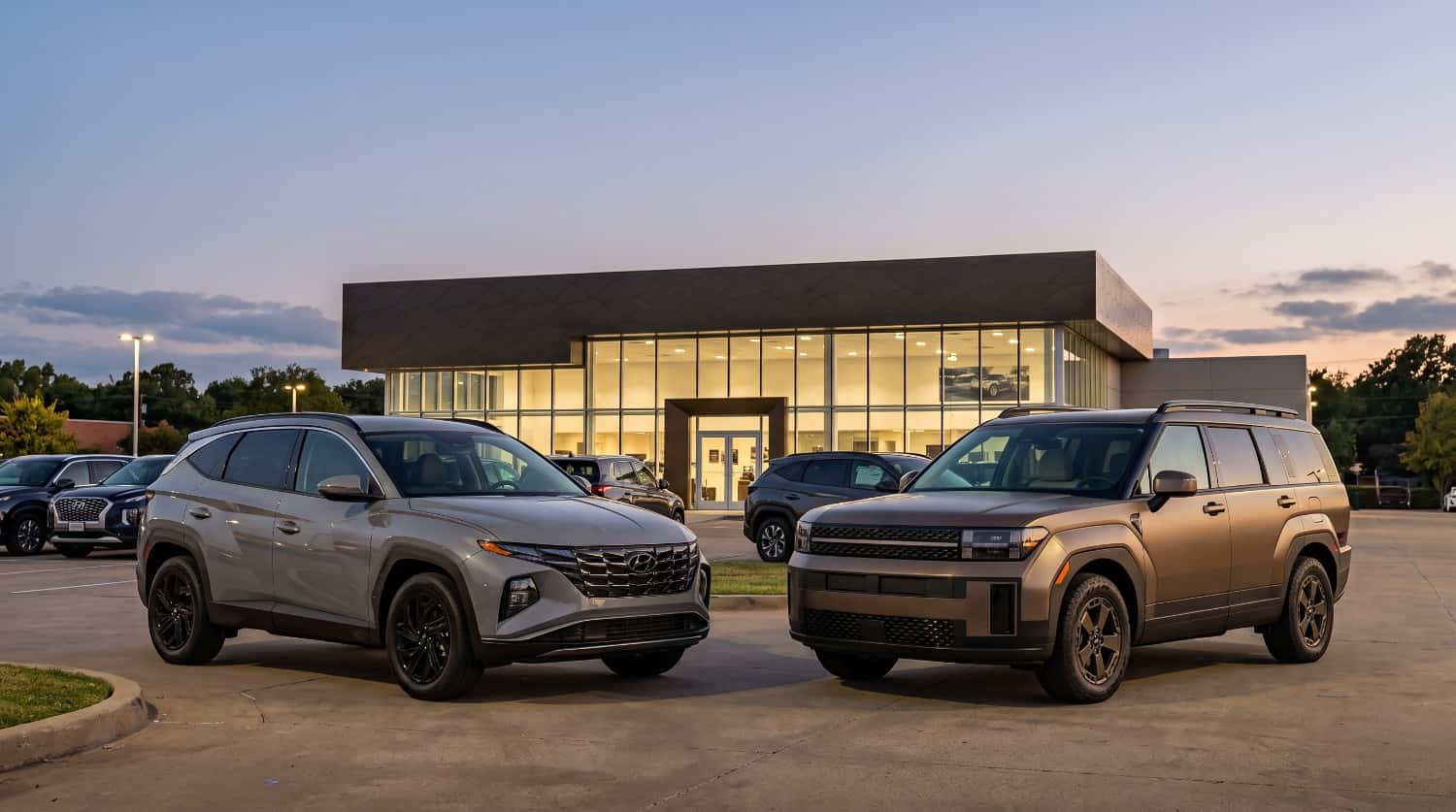
Picture this: you are walking the lot at James Hodge Hyundai in Muskogee on a sunny Saturday, staring at two sharp front grilles. On your left sits the athletic, sculpted 2026 Hyundai Tucson. On your right is the bold, boxy 2026 Hyundai Santa Fe. Both look fantastic, but they serve distinct driver profiles.
When evaluating the Hyundai Tucson vs Santa Fe, the core choice comes down to vehicle footprint and seating capacity. The compact Tucson is a 2-row, 5-passenger crossover engineered for maneuverability and efficient daily driving. The midsize Santa Fe is a 3-row, 6- to 7-passenger SUV built for growing families requiring extra passenger flexibility and squared-off cargo utility.
| Key Metric | 2026 Hyundai Tucson | 2026 Hyundai Santa Fe |
| Seating Capacity | 2 Rows / 5 Passengers | 3 Rows / 6–7 Passengers |
| Size Class | Compact SUV | Midsize 3-Row SUV |
| Starting Price | Lower starting MSRP | Premium tier (+5k–7k typical step-up) |
| Best For | Solo commuters, couples & small families | Growing families needing 3 rows & max cargo width |
(Specs and pricing vary by trim level; confirm current-year specs and pricing with our Muskogee sales team before you decide).
Key Takeaways
- Size difference: The Santa Fe is roughly eight inches longer and taller with a boxier footprint than the compact Tucson.
- Seating layout: Tucson seats up to five passengers across two rows, while Santa Fe includes standard three-row seating for six or seven.
- Cargo capacity: Tucson offers 38.7 cubic feet behind row two, whereas Santa Fe expands to 79.6 cubic feet with rear seats folded.
- Fuel efficiency: Gas Tucson models earn up to 28 MPG combined, slightly edging out the standard gas Santa Fe’s combined highway efficiency.
- Pricing gap: The Tucson starts at an accessible entry price, while the larger Santa Fe commands a step-up of roughly $5,000 to $7,000.
- Design and tech: Tucson features a sleek crossover profile, while Santa Fe provides an upright, adventure-ready design with dual wireless charging.
- The ideal buyer: Choose the Tucson for nimble daily commuting, or pick the Santa Fe if your family needs regular third-row versatility.
Hyundai Tucson vs Santa Fe: What’s the Core Difference?
At its foundation, this Tucson vs Santa Fe comparison comes down to segment size and family intent. The Hyundai Tucson occupies the compact crossover segment, providing an agile footprint, sleek styling, and two rows of seating for daily efficiency. In contrast, the Hyundai Santa Fe is a boxy, adventure-ready midsize SUV that steps up into standard three-row versatility, offering extra seating and substantial pulling power for bigger family demands.
| Feature | Hyundai Tucson | Hyundai Santa Fe |
| Vehicle Class | Compact 2-Row Crossover | Midsize 3-Row SUV |
| Seating Capacity | 5 Passengers | 6 to 7 Passengers |
| Starting MSRP | Around $30,800 (Base Gas) | Around $36,400 (Base Gas) |
| Powertrains Available | Gas (2.5L), Hybrid (1.6L Turbo), Plug-in Hybrid | Gas (2.5L Turbo), Hybrid (1.6L Turbo) |
| Body Style Profile | Sculpted, athletic, aerodynamic | Upright, geometric, rugged-box profile |
| Best For | Commuters, couples, small families | Growing families, road trips, cargo hauling |
(Starting MSRP estimates based on standard entry trims; confirm current-year specs and pricing with our team before you decide).
Dealer’s Take: At James Hodge Hyundai, we find that daily commuters and parents with one or two young kids usually fall in love with the Tucson for its easy parking along Main Street and punchy fuel economy. Meanwhile, shoppers with older kids, carpooling duties, or lake-bound weekend gear heading toward Fort Gibson Lake almost always step up to the Santa Fe for that crucial third row and broader cargo floor.
Tucson vs Santa Fe Size & Dimensions
Understanding the exterior Tucson vs Santa Fe size differences is critical before picking a spot in your driveway or garage. While the Tucson is crafted for effortless maneuvering through tight parking spots, the Santa Fe embraces a bold, wide-stance footprint that commands the road and yields serious cabin volume.
| Spec | Hyundai Tucson | Hyundai Santa Fe | Difference |
| Overall Length | 182.7 in | 190.2 in | Santa Fe is +7.5 in longer |
| Width | 73.4 in | 74.8 in | Santa Fe is +1.4 in wider |
| Height | 66.3 in (w/ roof rails) | 67.7–69.7 in (w/ rails) | Santa Fe is up to +3.4 in taller |
| Wheelbase | 108.5 in | 110.8 in | Santa Fe is +2.3 in longer |
| Ground Clearance | 7.1–8.3 in (X-RT) | 7.0–8.3 in (X-RT) | Comparable depending on trim |
| Curb Weight | ~3,350–4,000 lbs | ~4,100–4,500 lbs | Santa Fe is ~500–750 lbs heavier |
(All measurements reflect manufacturer specifications; confirm current-year specs and pricing with our team before you decide).
- Garage and tight-spot parking: That 7.5-inch difference in length means the Tucson slides effortlessly into compact parking stalls and standard suburban garages with plenty of walk-around room to spare.
- Cabin stability and legroom: The Santa Fe’s longer 110.8-inch wheelbase creates a settled, highway-cruising ride quality while carving out the necessary chassis space for third-row utility.
- Road stance: Santa Fe’s extra height and upright roofline give it a commanding, truck-inspired road presence, whereas the Tucson sports a low-slung, aerodynamic crossover profile.
Tucson vs Santa Fe Cargo Space
When evaluating Tucson vs Santa Fe cargo space, the Santa Fe wins on maximum volume and rear-opening width, while the Tucson holds a surprising advantage when all standard passenger seats are upright. The Tucson delivers 38.7 cubic feet behind its second row compared to the Santa Fe’s 14.6 cubic feet behind its third row, though folding the Santa Fe’s rear seats opens an expansive 79.6 cubic feet of flat hauling space.
| Cargo Area | Hyundai Tucson (2-Row) | Hyundai Santa Fe (3-Row) |
| Behind Row 3 | N/A | 14.6 cu ft |
| Behind Row 2 | 38.7 cu ft | 40.5 cu ft |
| Max Cargo (All Rear Seats Folded) | 74.8–80.3 cu ft (gas/hybrid) | 79.6 cu ft |
(Cargo volume varies slightly by powertrain and sunroof configuration; confirm current-year specs and pricing with our team before you decide).
- Weekly grocery runs with a stroller: The Tucson handles a double stroller plus six full grocery bags behind the second row without folding a single seat. The Santa Fe accomplishes the same easily, provided the third row is tucked flat.
- Youth sports gear & tournament weekends: Loading two large hockey bags, soccer pop-up tents, and folding chairs is straightforward in either vehicle, but the Santa Fe’s extra-wide, tailgate-style liftgate opening makes sliding bulky coolers in and out much easier.
- Family road trips for 4 to 5 passengers: For a family of five heading out on a multi-day trip, the Santa Fe lets you fold half of the third-row split bench for extra duffel bags while keeping generous rear passenger elbow room.
Tucson vs Santa Fe Interior & Seating
Stepping into the Tucson vs Santa Fe interior reveals two distinct approaches to cabin layout and passenger capacity. The Tucson focuses on spacious, two-row comfort for five with class-leading rear legroom, while the Santa Fe comes standard with three-row seating for six or seven, offering available second-row captain’s chairs for easier walk-through access.
| Interior Dimension | Hyundai Tucson | Hyundai Santa Fe |
| Front Headroom / Legroom | 40.1 in / 41.4 in | 41.1 in / 44.4 in |
| Second-Row Headroom / Legroom | 39.5 in / 41.3 in | 40.6 in / 42.3 in |
| Third-Row Headroom / Legroom | N/A | 37.7 in / 30.0 in |
| Total Passenger Volume | ~108.2 cu ft | ~152.0 cu ft |
(Dimensions vary slightly with panoramic sunroof options; confirm current-year specs and pricing with our team before you decide).
- Display setups: Tucson features standard 12.3-inch dual panoramic curved displays on higher trims, while the Santa Fe features a seamless panoramic curved panel integrating dual 12.3-inch driver and infotainment displays with high-definition clarity.
- Cabin materials & finishes: Tucson uses modern textures, stain-resistant cloth, or leather-trimmed seating, whereas Santa Fe steps toward luxury territory with available Nappa leather, eco-friendly microsuede headliners, and wood-pattern accents.
- Storage innovations: Santa Fe introduces a bi-directional center console openable from both front and rear rows, plus available dual wireless device charging pads. Tucson features deep center console storage with an open pass-through floor tray.
- Open-air feel: Both SUVs offer large panoramic sunroofs that flood the front and second rows with natural Oklahoma sunlight.
If you prioritize maximum second-row stretch-out room for teenagers, the Tucson delivers exceptional two-row space; if your weekly routine requires hauling extra neighborhood kids or carpooling groups, the Santa Fe is the clear winner.
Tucson vs Santa Fe MPG & Powertrain
Comparing Tucson vs Santa Fe MPG highlights a clear trade-off between compact efficiency and turbocharged muscle. Because the Tucson is lighter and offers dedicated plug-in hybrid tech, it delivers higher overall fuel economy. The heavier Santa Fe leans into robust standard turbocharged power to effortlessly carry three rows of passengers.
| Powertrain Variant | Hyundai Tucson Specs & MPG | Hyundai Santa Fe Specs & MPG |
| Standard Gas Engine | 2.5L 4-Cyl (187 hp / 178 lb-ft)
Up to 25 City / 32 Hwy / 28 Combined |
2.5L Turbo 4-Cyl (277 hp / 311 lb-ft)
Up to 20 City / 29 Hwy / 24 Combined |
| Hybrid (HEV) | 1.6L Turbo Hybrid (231 hp / 271 lb-ft)
Up to 38 City / 38 Hwy / 38 Combined |
1.6L Turbo Hybrid (~232 hp / 271 lb-ft)
Up to 36 City / 35 Hwy / 36 Combined |
| Plug-In Hybrid (PHEV) | 1.6L Turbo PHEV (268 hp combined)
~33 Miles All-Electric Range |
Not offered in U.S. lineup |
(EPA estimates vary by front-wheel drive vs. HTRAC all-wheel drive and wheel size; confirm current-year specs and pricing with our team before you decide).
- Towing ratings: Automotive reviewers consistently note that gas-powered Santa Fe models lead with a 3,500-lb rating (up to 4,500 lbs on the rugged XRT trim), whereas the gas Tucson pulls up to 2,750 lbs, fitting smaller utility trailers.
- Everyday road dynamics: The Tucson delivers a light, nimble driving character that zips through commuter traffic effortlessly. The Santa Fe provides a planted, quiet highway cruise with immediate passing authority courtesy of its 311 lb-ft of turbo torque.
MPG ratings and maximum towing capacities differ across trim levels and drivetrain setups, so be sure to check your chosen configuration before purchase
Tucson vs Santa Fe Price & Trim Levels
Examining the Tucson vs Santa Fe price structure reveals how Hyundai steps buyers up through its trim ladders. The Tucson base SE starts under 35,000 range
due to its standard turbocharged engine and standard three rows. Whether you choose the Hyundai Tucson or Santa Fe, both follow an easy-to-navigate hierarchy from entry SE up to premium Limited and Calligraphy grades.
| Trim Level | 2026 Hyundai Tucson (Gas MSRP) | 2026 Hyundai Santa Fe (Gas MSRP) |
| SE | Starting around $29,450 | Starting around $35,050 |
| SEL | Starting around $30,800 | Starting around $37,590 |
| XRT (Rugged Styling) | Starting around $33,475 | Starting around $42,040 |
| Limited | Starting around $39,425 | Starting around $44,600 |
| Calligraphy | N/A (Limited is top gas trim) | Starting around $47,600 |
(Starting MSRPs exclude freight/destination, taxes, and dealer fees; confirm current-year specs and pricing with our team before you decide).
- The standard equipment jump: The roughly $5,600 starting price difference gets you standard 277-hp turbo performance, standard three-row seating, and larger standard utility space in the Santa Fe.
- Trim-for-trim value: A mid-tier Tucson SEL or SEL Convenience delivers luxury-adjacent features like a smart liftgate and dual displays at a price point well below a base midsize SUV.
- Flagship luxury options: If you want top-tier amenities like Nappa leather seating surfaces and second-row captain’s chairs, the Santa Fe Calligraphy offers a premium experience that rivals dedicated luxury brands.
At James Hodge Hyundai, our finance specialists are ready to walk you through current Hyundai factory incentives, trade-in valuations for your current vehicle, and competitive financing programs to fit your monthly budget.
Hyundai Tucson or Santa Fe: Which One Should You Buy?
Deciding whether the Hyundai Tucson or Santa Fe deserves the spot in your garage comes down to daily lifestyle, passenger counts, and travel habits. Use these profiles to find your ideal match:
- The City and Suburb Commuter (Choose Tucson): If your weekly miles consist of tight parking structures, school drop-off lanes, and solo commuting, the Tucson’s tidy dimensions and higher MPG will save both fuel and stress.
- The Growing Family (Choose Santa Fe): When your household is expanding or you frequently volunteer for sports carpools, the Santa Fe’s standard three rows and versatile walk-through captain’s chairs deliver the extra room you need.
- The Road-Trip Enthusiast (Choose Santa Fe): For frequent travelers packing camping gear, coolers, and luggage for four or five passengers, the Santa Fe provides a settled highway wheelbase, punchy turbo passing power, and 4,500-lb max towing capability.
- The First-Time SUV Buyer on a Budget (Choose Tucson): Drivers moving up from a sedan who want elevated ride height, advanced safety tech, and ample cargo volume without taking on a midsize SUV price tag will find exceptional value in the Tucson SE or SEL.
In short, choose the Tucson if you prioritize lower overall ownership costs, agile city parking, and maximum fuel economy; choose the Santa Fe if your family requires standard third-row seating, higher towing capacity, and expansive cargo width.
Why Trust This Comparison? Our Experience with Both SUVs
This comparison reflects the hands-on insights of the product and sales specialists at James Hodge Hyundai in Muskogee, Oklahoma. Every week, our team helps drivers from Muskogee, Broken Arrow, Tulsa, and McAlester test-drive both models back to back, load strollers and sports equipment into their cargo holds, and calculate real-world monthly ownership costs. We see firsthand how these vehicles perform under real family routines.
Our technical specifications, dimensions, and performance benchmarks are verified against official manufacturer data from HyundaiUSA.com and cross-referenced with reputable independent industry testers, including Car and Driver, MotorTrend, and Edmunds. This ensures the horsepower figures, cargo measurements, and fuel economy numbers you read here accurately reflect real production models.
Automotive specifications, trim packaging, available incentives, and manufacturer pricing fluctuate across model years and regional distribution channels. While we strive to maintain complete data precision, we encourage every shopper to verify active inventory details, exact window stickers, and current financing programs directly with our Muskogee showroom before completing a purchase.
Local Insight: Green Country drivers have unique demands. Many of our Tulsa and Broken Arrow commuters choose the Tucson for its easy handling along Highway 51 and Highway 64, while families heading down to Lake Eufaula, Tenkiller, or Fort Gibson lean heavily into the Santa Fe for its 4,500-lb towing capacity and wide cargo deck that swallows coolers, fishing tackle, and camp chairs without breaking a sweat.
Final Verdict: Hyundai Tucson vs Santa Fe
Choosing between the Hyundai Tucson vs Santa Fe ultimately hinges on your daily spatial demands, passenger headcount, and fuel priorities. The Tucson stands out as an agile, highly efficient two-row crossover that keeps ownership costs low while offering plenty of cabin room for small families and commuters. In contrast, the Santa Fe delivers rugged three-row versatility, bold boxy styling, standard turbo punch, and heavy-duty towing for active households on the move.
Ready to see how both models look and drive in person? Visit James Hodge Hyundai at 1330 North Main St in Muskogee, OK, to explore our extensive new inventory and compare trims side by side. Call our sales team today at 918-228-5518 or browse our lineup online at jameshodgehyundai to schedule your back-to-back test drives.
Frequently Asked Questions:
Is Santa Fe just a bigger Tucson?
No, the Santa Fe is built on a distinct platform designed for midsize three-row capability and higher towing capacities, rather than simply being an elongated Tucson. It features standard turbocharged performance, squared-off exterior proportions, and unique cabin layouts like available second-row captain’s chairs.
Does the Hyundai Tucson come in a hybrid?
Yes, the Hyundai Tucson offers both a standard Hybrid (HEV) and a Plug-in Hybrid (PHEV) powertrain variant alongside its standard gas engine. The Tucson Hybrid delivers up to 38 MPG combined, making it an exceptionally efficient choice for daily commuting.
Can the Santa Fe seat 7 passengers?
Yes, the Hyundai Santa Fe comes standard with three-row seating that accommodates up to seven passengers when equipped with the second-row bench seat. Upper trim levels, such as the Calligraphy, feature second-row captain’s chairs that adjust total seating capacity to six.
Which is better for towing a small boat or camper?
The Hyundai Santa Fe is better equipped for towing, offering a maximum capacity of 3,500 to 4,500 lbs on gas-powered models compared to the Tucson’s 2,000 to 2,750-lb rating. This makes the Santa Fe suitable for small utility trailers, fishing boats, and lightweight campers.
Is the Hyundai Tucson or Santa Fe better for teen drivers?
The Hyundai Tucson is generally better for newer and teen drivers due to its compact dimensions, tighter turning radius, and standard suite of Hyundai SmartSense safety features. Its lower starting price and higher fuel economy also keep ongoing operating costs manageable.
Which SUV has better gas mileage?
The Hyundai Tucson provides better overall fuel economy, earning up to 28 MPG combined in gas models and 38 MPG combined in hybrid form. The Santa Fe’s larger footprint and standard turbo engine yield slightly lower figures, reaching up to 24 MPG combined for gas and 36 MPG for hybrid.
How much more expensive is the Santa Fe than the Tucson?
The Santa Fe typically costs about $5,000 to $7,000 more than a comparable Tucson trim level. That price gap accounts for the Santa Fe’s standard turbocharged engine, three-row seating configuration, and larger cabin volume.
Can both SUVs be test-driven at James Hodge Hyundai?
Yes, both the Hyundai Tucson and Santa Fe are available for side-by-side test drives and walkarounds at James Hodge Hyundai in Muskogee, OK. Our product specialists can help you compare trims, seating configurations, and features in person.
0 comment(s) so far on 2026 Hyundai Tucson vs Santa Fe: Which SUV Should You Buy?