


2026 Hyundai Tucson vs Kia Sportage: Which SUV Actually Wins?
Finding the perfect compact SUV can feel like trying to choose between two identical options. If you are cross-shopping the crossover market, you will almost immediately land on two heavy hitters from South Korea. Both options promise sharp styling, loaded tech suites, and industry-leading value.
Our team at James Hodge Hyundai hears from local drivers every single week who are torn right down the middle on this exact choice. It is a classic head-scratching dilemma because these two vehicles share a common parent corporate structure, yet they look and feel entirely different once you get behind the wheel.
Whether you need a fuel-sipping hybrid for your daily commute or a spacious family hauler with enough cargo space for a weekend road trip, choosing between the Hyundai Tucson and its corporate sibling requires looking past the surface. We have put both of these crossovers through real-world testing to give you the exact breakdowns you need.
Quick Answer
When choosing between the 2026 Hyundai Tucson vs Kia Sportage, the choice ultimately comes down to your personal design preferences, interior layout needs, and trim value. The Hyundai Tucson delivers a more refined, upscale styling approach with traditional physical climate buttons, slightly higher maximum cargo capacity, and premium tech configurations. Meanwhile, the Kia Sportage leans into a rugged, blocky design language and offers slightly more rear legroom. Both vehicles share standard 187-horsepower engines, identical 10-year/100,000-mile warranties, and highly efficient hybrid options, but the Tucson offers a more cohesive daily driving experience.
Key Takeaways
- Shared Power Plants: Both crossovers come equipped with a standard 2.5-liter four-cylinder engine making 187 horsepower, routed through an eight-speed automatic transmission.
- Cabin Layout Philosophies: The Tucson features an elegant dual-screen layout with dedicated physical controls, while the Sportage uses a curved panoramic housing.
- Stellar Warranty Coverage: You get an industry-best 10-year/100,000-mile powertrain warranty with both models, but Hyundai adds three years of complimentary maintenance.
- Electrified Efficiency: Upgrading to the hybrid variants bumps your output to over 230 horsepower while pushing fuel economy past 38 combined MPG.
- Cargo Configurations: The Tucson provides up to 74.8 cubic feet of maximum cargo room, edging out the Sportage by a fraction of a cubic foot.
2026 Hyundai Tucson vs Kia Sportage at a Glance
| Feature | 2026 Hyundai Tucson | 2026 Kia Sportage |
| Vehicle Segment | Compact Crossover SUV | Compact Crossover SUV |
| Base Engine | 2.5L 4-Cylinder | 2.5L 4-Cylinder |
| Standard Horsepower | 187 hp | 187 hp |
| Max Hybrid Horsepower | 231 hp | 232 hp |
| Max EPA-Estimated MPG | 25 City / 33 Hwy / 28 Combined | 25 City / 33 Hwy / 28 Combined |
| Max Cargo Space | 74.8 cubic feet | 74.1 cubic feet |
| Starting MSRP (Base) | $29,450 | $28,790 |
| Ideal Buyer Profile | Tech-focused families seeking refinement | Drivers wanting a rugged, blocky appearance |
What’s the Real Difference Between the Tucson and Sportage?
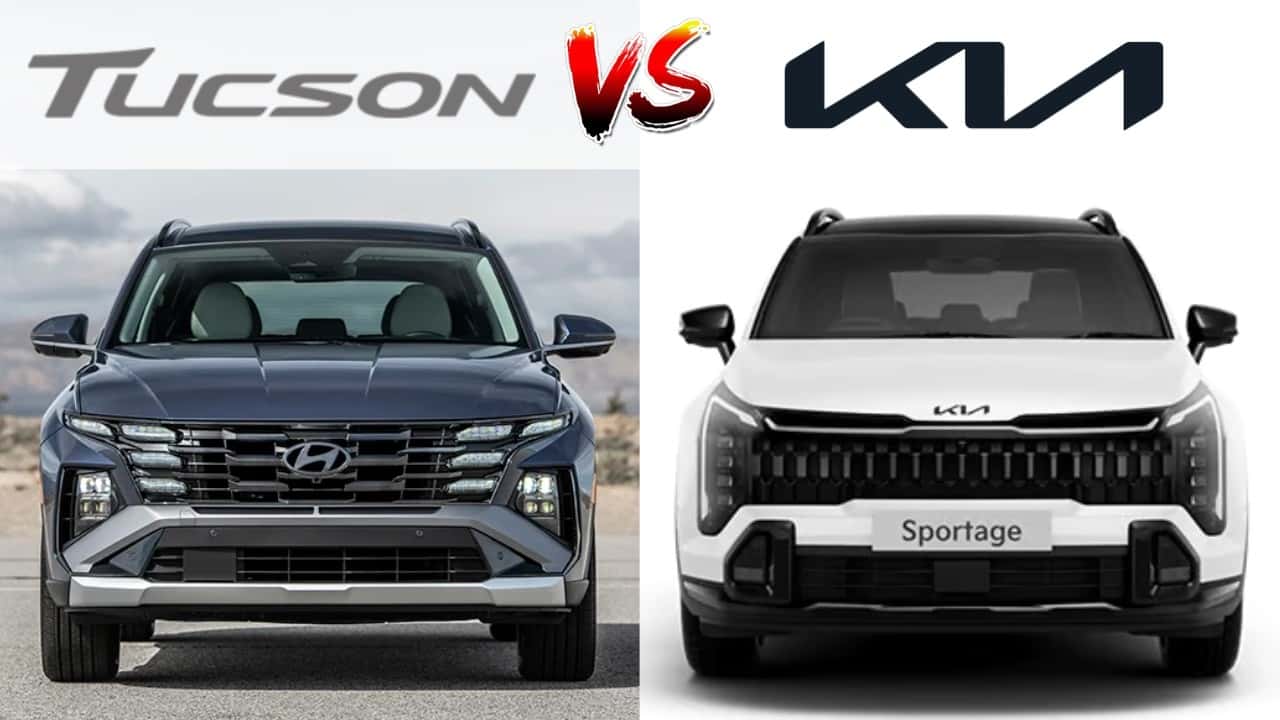
While these two SUVs are built on the same global platform, they cater to very different personalities. Think of them as fraternal twins raised in different environments. The Hyundai Tucson approaches the compact segment with a focus on modern geometric design, featuring integrated daytime running lights hidden directly within a jewel-like grille. It feels high-end and upscale, almost like an entry-level luxury vehicle when you step into the top-tier trims.
On the flip side, the Sportage tries hard to prove its rugged outdoor credentials. With its blocky silhouette, distinctive boomerang-shaped daytime running lights, and prominent black cladding on off-road trims, it aims for a more aggressive look. Inside the cabin, the branding choices separate them even further. Hyundai prioritizes clean aesthetics and ergonomic layouts, whereas Kia prefers high-contrast color schemes and a heavy dose of glossy piano black trim.
Hyundai Tucson vs Kia Sportage Dimensions
Don’t let the marketing fool you; these vehicles occupy almost the same footprint on your driveway. Parking either one in a tight suburban garage will feel identical. However, the fractional design differences create unique packaging results inside the cabin.
| Dimension Metric | 2026 Hyundai Tucson | 2026 Kia Sportage |
| Wheelbase | 108.5 inches | 108.5 inches |
| Overall Length | 183.1 inches | 183.5 inches |
| Overall Width | 73.4 inches | 73.4 inches |
| Overall Height | 65.6 inches | 65.4 inches |
| Front Legroom | 41.4 inches | 41.4 inches |
| Rear Legroom | 41.3 inches | 41.3 inches |
The practical takeaway here is that neither vehicle feels cramped. Both manufacturers have stretched their wheelbases to the absolute limit of the compact class. This engineering trick means you can easily fit rear-facing child seats or tall adults in the second row without forcing the driver to slide their seat forward. If you frequently take long road trips with adult passengers, both choices keep complaints to an absolute minimum.
Hyundai Tucson vs Kia Sportage Interior & Cargo Space
Step inside the cabins, and the visual layout changes drastically. The Hyundai Tucson vs Kia Sportage interior battle comes down to how you interact with your vehicle daily. Following a recent refresh, the Tucson features a striking panoramic curved display housing dual 12.3-inch screens. Crucially, Hyundai listened to feedback and retained dedicated, physical clicky buttons for high-use climate settings and audio volume. It prevents you from taking your eyes off the road just to turn down the air conditioning.
The Sportage utilizes a similar dual-screen configuration, but combines the climate and audio controls into a single dynamic touch panel. You have to press a button to toggle the physical knobs between adjusting the volume or changing the cabin temperature. It can lead to accidental volume blasts when you actually wanted to cool down the cabin.
Let us look closely at how the Hyundai Tucson vs Kia Sportage cargo space breaks down below:
| Cargo Location | 2026 Hyundai Tucson | 2026 Kia Sportage |
| Cargo Space (Seats Up) | 38.7 cubic feet | 39.6 cubic feet |
| Cargo Space (Seats Folded) | 74.8 cubic feet | 74.1 cubic feet |
| Passenger Volume | 108.2 cubic feet | 108.0 cubic feet |
| Rear Seat Configuration | 60/40 Split-Fold Flat | 60/40 Split-Fold Flat |
If you are packing up large boxes or camping gear, the Tucson holds a slight advantage when you drop the second-row seats flat. Its square tail-gate opening and lower load floor make sliding heavy items inward a breeze. The dual-level cargo floor in the Tucson also lets you hide valuable items out of plain sight.
Tucson vs Sportage MPG & Fuel Economy
Gas prices fluctuate constantly, which makes fuel efficiency a top priority for most crossover shoppers. If you stick with the standard internal combustion engines, the Tucson vs Sportage MPG figures run neck and neck because they share identical drivetrains. Both models yield solid numbers for non-hybrid compact crossovers.
Let us look at the official EPA ratings for the gas-powered configurations:
- Front-Wheel Drive Models: 25 City / 33 Highway / 28 Combined MPG for both vehicles.
- All-Wheel Drive Models: 24 City / 30 Highway / 26 Combined MPG for both vehicles.
Hyundai Tucson Hybrid vs Kia Sportage Hybrid
If you want to maximize your fuel savings, looking into the Hyundai Tucson hybrid vs Kia Sportage hybrid variants is a smart move. Electrification completely changes the personality of these SUVs. Instead of a standard engine, the hybrid models use a punchy 1.6-liter turbocharged four-cylinder engine paired with an electric motor. This setup provides much quicker acceleration alongside stellar city fuel economy.
| Drivetrain Variant | Tucson Hybrid MPG | Sportage Hybrid MPG |
| Base Hybrid FWD | 38 City / 38 Hwy / 38 Combined | 41 City / 44 Hwy / 42 Combined |
| Standard Hybrid AWD | 36 City / 37 Hwy / 36 Combined | 38 City / 38 Hwy / 38 Combined |
While the Sportage Hybrid posts slightly higher maximum efficiency numbers on paper in its base front-wheel-drive trim, most buyers choose all-wheel drive for winter traction. In real-world driving conditions, both systems use smart regenerative braking to store power every time you coast down a hill, dramatically cutting your monthly fuel bill.
While the Sportage Hybrid posts slightly higher maximum efficiency numbers on paper in its base front-wheel-drive trim, most buyers choose all-wheel drive for winter traction. In real-world driving conditions, both systems use smart regenerative braking to store power every time you coast down a hill, dramatically cutting your monthly fuel bill.
Hyundai Tucson vs Kia Sportage Price & Trim Comparison
Budget rules supreme during any car shopping journey. The Hyundai Tucson vs Kia Sportage price comparison reveals how each brand structures its value proposition across different price tiers. Hyundai leans into packaging hot features into comprehensive trim levels, while Kia offers more standalone variations.
| Trim Tier | 2026 Hyundai Tucson MSRP (FWD) | 2026 Kia Sportage MSRP (FWD) |
| Base Model | $29,450 (SE Trim) | $28,690 (LX Trim) |
| Mid-Tier Value | $30,800 (SEL Trim) | $30,490 (EX Trim) |
| Rugged Edition | $33,475 (XRT Trim) | $32,990 (X-Line – Standard AWD) |
| Top-Tier Luxury | $39,425 (Limited Trim) | $36,290 (SX Prestige Trim) |
Trim-by-Trim Value Breakdown
- The Entry-Level Battle: The Sportage LX starts with a slightly lower sticker price, but the Tucson SE responds by giving you standard safety features that often cost extra elsewhere.
- The Sweet Spot Trims: Step up to the Tucson SEL, and you gain access to the highly popular convenience upgrades without having to pay top-tier pricing. It represents the best overall balance of tech and price in the entire lineup.
- Premium Finishes: At the high end, the Tucson Limited justifies its price point by packing in premium leather seating, a brilliant surround-view camera system, and automated parking features that make daily driving effortless.
Performance, Towing Capacity & Driving Experience
When you hit the highway, these two vehicles show off unique suspension tunings. The standard 2.5-liter base engine produces 187 horsepower and 178 pound-feet of torque. Paired with a traditional eight-speed automatic transmission, both vehicles deliver predictable, steady acceleration rather than spine-tingling speed.
The difference lies entirely in how they handle local potholes. Hyundai tuned the Tucson with a slight premium bias. The dampers absorb harsh expansion joints smoothly, creating a quiet and serene cabin experience at highway speeds. The Sportage uses a slightly stiffer spring setup. While it feels a tiny bit more athletic when tossing it into a sharp corner, you will feel more road imperfections through the seat bottom.
So what about the Hyundai Tucson vs Kia Sportage towing capacity limits?
- Hyundai Tucson: Maximum towing capacity sits at 2,000 pounds when properly equipped with trailer brakes.
- Kia Sportage: Maximum towing capacity maxes out at 2,500 pounds under specific trailering setups.
If you plan to tow a pair of jet skis or a small utility trailer to the lake, both crossovers handle light-duty hauling duties with ease. However, remember that compact crossovers are not built for pulling massive heavy campers. Always make sure to account for passenger and cargo weight when calculating your total trailer weight.
Hyundai Tucson vs Kia Sportage Technology
Modern cabins live and die by their connectivity features. In this arena, the Hyundai Tucson vs Kia Sportage technology matchup showcases incredible screen real estate. Both SUVs feature standard wireless Apple CarPlay and Android Auto integration, meaning you can drop your phone on the console and instantly see your navigation apps pop onto the main dashboard.
Hyundai takes the lead with its updated infotainment software, which supports seamless over-the-air updates. The layout is highly intuitive, using high-contrast menus that do not require digging through nested settings just to find your favorite radio station. Furthermore, higher trims offer the excellent Hyundai Digital Key 2 Touch feature. This allows you to completely leave your physical keys at home and lock, unlock, or start your vehicle using just your compatible smartphone or Apple Watch.
Tucson vs Sportage Safety
Keeping your family safe is a non-negotiable requirement. Thankfully, both manufacturers prioritize comprehensive structural protection. Looking at Tucson vs Sportage safety metrics reveals top-tier validation from independent testing authorities.
Both vehicles regularly earn prestigious Top Safety Pick awards from the Insurance Institute for Highway Safety (IIHS) and secure five-star overall safety ratings from the National Highway Traffic Safety Administration (NHTSA). The foundational safety design on both options is robust.
Standard active safety highlights include:
- Forward Collision-Avoidance Assist: Monitors cars, pedestrians, and cyclists ahead, automatically applying the brakes if a sudden stop occurs.
- Lane Keeping Assist & Lane Following Assist: Gently nudges your steering wheel to keep you perfectly centered between the white lines.
- Blind-Spot Collision Warning: Flashes a bright alert icon in your side mirrors if a vehicle hides in your hard-to-see quarters.
- Rear Cross-Traffic Collision-Avoidance: Scans behind your bumper when backing out of busy supermarket parking spots, stopping the car if an oncoming vehicle approaches.
Hyundai Tucson vs Kia Sportage Reliability
When you invest your hard-earned money into a new vehicle, you want to ensure it stays out of the service bay. The Hyundai Tucson vs Kia Sportage reliability comparison shows that both brands have built strong reputations over the past decade. They consistently rank near the top of J.D. Power dependability studies.
The ultimate peace of mind comes down to warranty protection. Both vehicles feature standard warranties that obliterate their domestic and Japanese competitors:
- Limited Warranty: 5 years or 60,000 miles.
- Powertrain Warranty: 10 years or 100,000 miles.
The Hyundai Ownership Advantage
This is where Hyundai pulls ahead in a significant way for budget-conscious buyers. Every new 2026 Hyundai Tucson comes standard with Hyundai Complimentary Maintenance. For the first 3 years or 36,000 miles, your scheduled oil changes, tire rotations, and multi-point inspections cost absolutely nothing. Kia does not offer a standard equivalent program, meaning you will be paying out of pocket for all basic upkeep right from day one.
Which SUV Is Better for Unique Driving Scenarios?
The Daily City Commuter
If your weekday involves navigating heavy stop-and-go traffic and squeezing into tight parallel parking spots, the Hyundai Tucson takes the crown. Its progressive steering is lighter at lower speeds, making sharp U-turns effortless. Additionally, the inclusion of dedicated physical buttons for climate and audio means less distracted driving while managing heavy traffic.
The Weekend Outdoor Explorer
If you spend your Saturdays driving down washboard dirt roads to reach isolated trailheads, the Kia Sportage offers an edge through its off-road-oriented trims. The Sportage X-Line and X-Pro variants add a fraction of an inch of extra ground clearance and come fitted with all-terrain tires that handle loose gravel and mud slightly better than standard all-season rubber.
Final Decision Triggers: How to Choose
Choose the Hyundai Tucson If:
- You prefer an elegant, futuristic exterior design that looks premium.
- You want the financial savings of 3 years of complimentary maintenance.
- You prefer traditional physical climate and volume buttons over digital toggle menus.
- You need maximum cargo space when folding the rear seats completely flat.
Choose the Kia Sportage If:
- You want a boxy, rugged look reminiscent of old-school off-roaders.
- You need a slightly higher 2,500-pound maximum towing limit for light trailers.
- You prefer a highly modern curved panoramic screen housing layout.
- You frequently transport adults who prefer a bit more fixed rear legroom.
Why Buy From James Hodge Hyundai?
Choosing the right SUV is only half the battle; finding a dealership that respects your time and budget matters just as much. At James Hodge Hyundai, we pride ourselves on providing a transparent, stress-free buying experience.
Our team knows the Hyundai lineup inside and out. We are proud to serve our community with an extensive inventory of new Tucson models, competitive financing options tailored to your budget, and a state-of-the-art service center dedicated to keeping your vehicle running smoothly for years to come. When you shop with us, you are family.
Conclusion
The compact crossover segment is full of great choices, but the 2026 Hyundai Tucson vs Kia Sportage rivalry proves that distinct personalities can live on the same foundation. While the Sportage leans heavily into rugged outdoor themes, the Hyundai Tucson wins out for the vast majority of drivers by offering a more refined ride, better layout choices, and unmatched long-term value thanks to three years of free maintenance.
Ready to experience the difference for yourself? Stop by James Hodge Hyundai today to explore our new inventory, take a test drive, and find the perfect crossover for your driveway.
Frequently Asked Questions
Is the Hyundai Tucson bigger than the Kia Sportage?
No, they are almost identical in size. Both vehicles share a 108.5-inch wheelbase, though the Sportage is less than half an inch longer overall.
Which has better fuel economy, Tucson or Sportage?
Standard gas models deliver identical fuel economy at 28 combined MPG with front-wheel drive. In hybrid configurations, the Sportage Hybrid offers a small advantage on paper depending on the specific trim level you select.
Is the Kia Sportage or Hyundai Tucson more reliable?
Both crossovers score exceptionally well in long-term reliability metrics and share the same 10-year/100,000-mile warranty. However, the Tucson saves you more money over time by including three years of standard complimentary maintenance.
How much can the Hyundai Tucson tow compared to the Kia Sportage?
The Hyundai Tucson handles up to 2,000 pounds when using trailer brakes. The Kia Sportage maxes out slightly higher at 2,500 pounds under optimal trailering setups.
Which SUV has more cargo space, Tucson or Sportage?
The Sportage offers slightly more space behind the second row, but the Hyundai Tucson wins on maximum capacity, providing 74.8 cubic feet of flat loading room when the rear seats are folded down.
Is the Tucson Hybrid better than the Sportage Hybrid?
The Tucson Hybrid stands out by offering standard all-wheel drive across its most popular value trims and delivering smooth, refined ride quality that handles city streets beautifully.
0 comment(s) so far on 2026 Hyundai Tucson vs Kia Sportage: Which SUV Actually Wins?